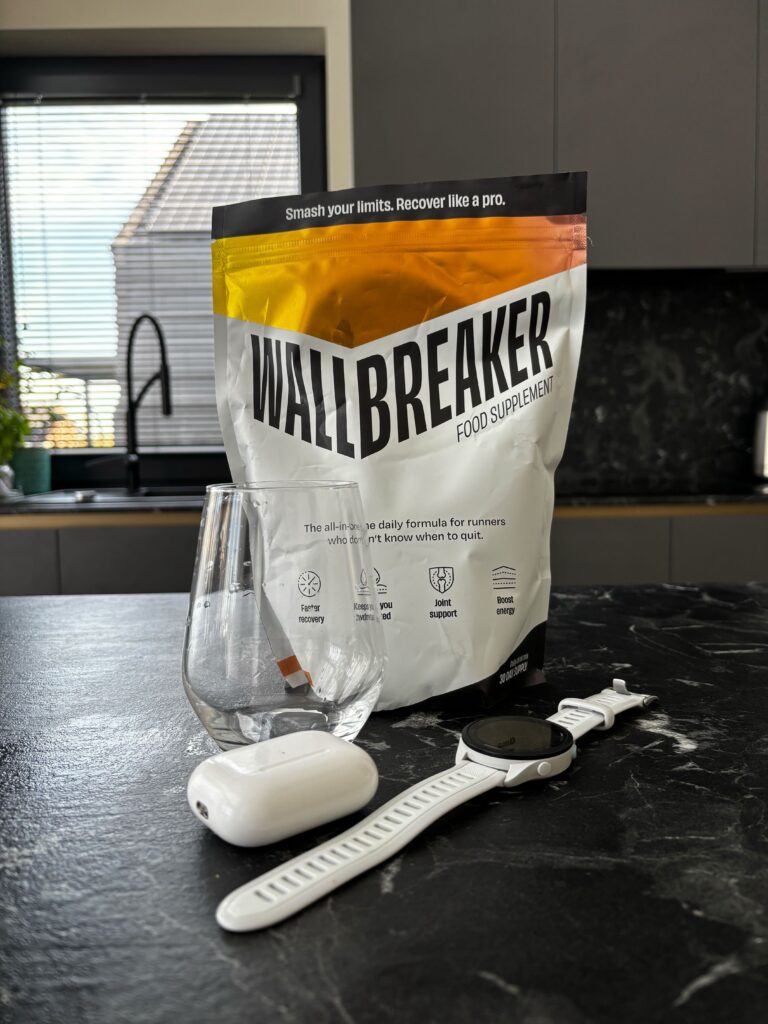
Wallbreaker is a genuinely good daily formula for runners, and it does something most all-in-one powders don’t bother with: it actually dose-stacks the right ingredients at the right amounts for endurance training. The orange flavour is clean rather than sweet. The 24g single-scoop format is the right call. Recovery between back-to-back runs noticeably improved by week two.
The price is the friction point. £55 a month is not impulse territory, and the brand does itself no favours by not being more upfront about the cost-per-serving comparison. Once you’ve done the maths, the value argument holds. Getting to that point takes a bit of work.
Best for: Runners doing three or more sessions a week who already take two or three separate supplements and want to consolidate. Good for casual runners too.
What is Wallbreaker, actually?
Wallbreaker is a daily food supplement in powder form, sold in 30-day pouches at £55. One 24g scoop into 250ml of cold water, drink it, that’s the routine. It’s marketed specifically at runners, not the general fitness crowd, and the formula reflects that. We’ll get into the ingredient breakdown below, but the short version is: it covers the bases a runner doing serious mileage actually needs (joint inflammation, recovery, hydration, energy, sleep quality) rather than the bases a gym-bro powder thinks you need (creatine, mass-gain calories, pre-workout stimulants).
The brand is UK-based, manufactured to GMP standards, and the formula is vegan, halal, kosher, and non-GMO. None of that mattered to us going in. What we wanted to know was simpler: does it work, does it taste alright, and is it worth the money.
We ran a 30-day test. Here’s what happened.
First impressions and unboxing
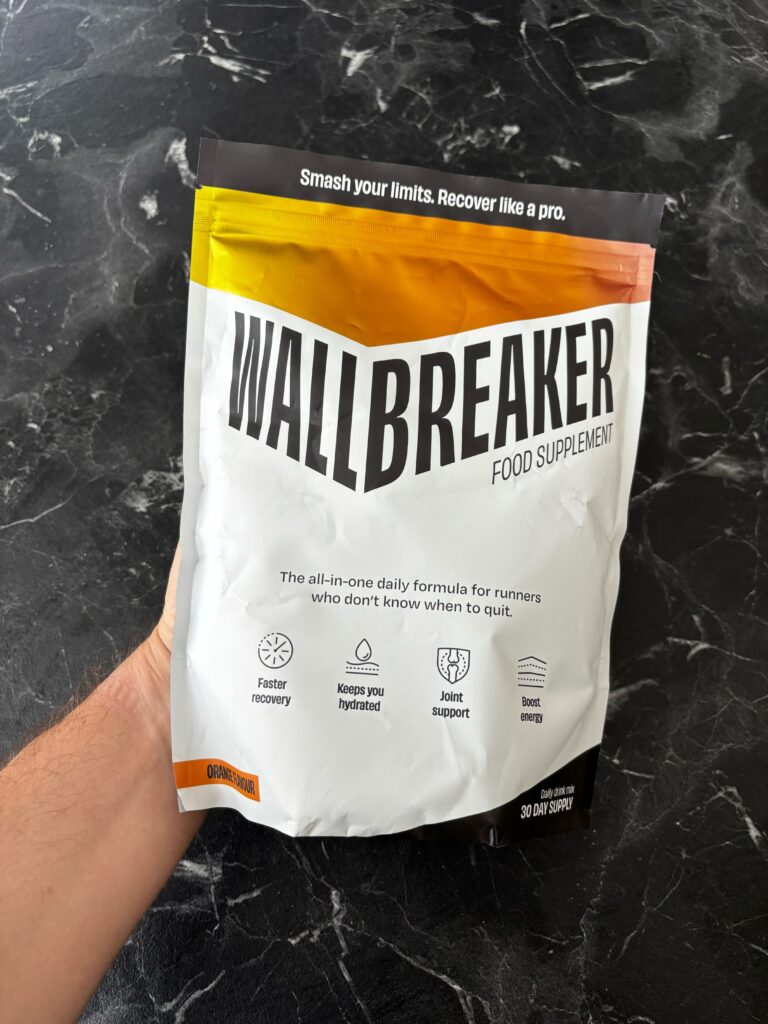
The pouch arrived in a plain cardboard mailer, no excessive packaging, no glossy leaflets, no scoop in a separate sachet. The pouch itself is matte white with the black wordmark and an orange/amber strip across the top. It feels premium without trying too hard. Resealable zip closure that actually works after a week of daily use, which sounds like a low bar but anyone who’s bought a supplement pouch knows it isn’t.
The scoop is inside the pouch, buried in the powder. First niggle. It’s a small thing, but fishing around in a 720g bag of orange powder on day one to find the scoop is a bit annoying. A scoop clipped to the inside of the seal would be a cheap fix.
The powder itself is a white, fine but not dusty. It smells like orange squash concentrate, not artificial, not chemical. Good first sign.
The flavour, properly
This is the bit most reviews skim over and it’s the bit that matters most when you’re drinking something every day for a year.
Wallbreaker is orange flavoured and they’ve made a sensible decision: it tastes like proper orange (my wife said it tasted citrusy), not orange sweets. There’s a slight tartness to it, almost like a watered-down San Pellegrino Aranciata, with a faint herbal edge underneath that’s probably the turmeric and the B-complex coming through. It is not sweet. That’s important. Most daily greens and recovery powders go heavy on stevia or sucralose to mask the ingredient base, and after a week you can’t drink them anymore. Wallbreaker uses a much lighter sweetening approach. The first sip on day one we actually thought it was under-sweetened. By day three we were grateful for it.
There’s a very mild graininess on the tongue if you drink it too quickly. Not gritty, more like fine sediment. Stir it again halfway through and it goes. In a shaker bottle with twenty seconds of shaking it dissolves cleanly. In a glass with a spoon it takes about thirty to forty seconds of stirring to get there.
Cold water works far better than room temperature. We tried it warm once on a cold Sunday morning thinking it might work as a hot drink. It does not. Stick to cold.
A few flavour notes from the 30 days:
- After a long run on a hot day, it’s genuinely refreshing. The electrolytes and the citrus actually work together properly.
- First thing in the morning on an empty stomach, the turmeric note is more noticeable. Not unpleasant, just there.
- Mixed with sparkling water instead of still, it’s significantly better. The brand should suggest this on the pouch.
- After day fifteen or so, you stop noticing the flavour entirely. It becomes background, which is what you want from a daily supplement.
If you hate orange, you’re stuck. Wallbreaker only does one flavour. That’s a limitation and worth flagging.
What it’s actually for
The formula is built around five things runners care about: recovery between sessions, joint health, hydration, sustained energy, and sleep quality. Each of those is targeted by specific ingredients at specific doses.
Recovery and muscle repair. The BCAA blend (leucine, isoleucine, valine) is dosed at a level that actually does something rather than being a label decoration. BCAAs are reasonably well evidenced for reducing exercise-induced muscle soreness, particularly in the 24 to 72 hour window post-session. Combined with the magnesium glycinate, this is the part of the formula we noticed first. By the end of week one, the dull leg fatigue that usually sits with us through Tuesday after a Sunday long run was clearly reduced.
Joint health and inflammation. Curcumin (the active compound in turmeric) with piperine for absorption. This is the headline ingredient. Curcumin has solid evidence for reducing inflammatory markers in endurance athletes, and piperine increases its bioavailability by something like twenty fold. Wallbreaker dose this properly. We have a slightly cranky right knee from years of road miles, and by week three it was noticeably quieter on easy runs. Hard to say what’s placebo and what’s pharmacology with anti-inflammatories, but the effect was there.
Hydration. A proper electrolyte blend (sodium, potassium, magnesium) rather than a token sprinkle. This is where Wallbreaker beats most “greens” products. On hot runs and the day after, the difference in how we felt was clear. Less of that hollow, slightly hungover feeling you get after a long Sunday in the sun.
Energy and focus. B-complex (B1, B2, B3, B5, B6, B12) plus vitamin D3 plus L-theanine. The B-complex is doing the metabolic heavy lifting. The L-theanine is the smart bit. It’s the same compound that takes the edge off coffee jitters, and pairing it with the rest of the formula gives the drink a calm-but-alert feeling. Not stimulating in the caffeine sense. More like the static in your head dialling down a notch.
Sleep quality. Magnesium glycinate at a meaningful dose. Magnesium is one of the most consistently under-supplied minerals in athletes, and the glycinate form is the one with the best evidence for sleep and recovery. We took Wallbreaker in the morning throughout the test, and sleep quality still improved noticeably by week two. Falling asleep faster, fewer 4am wake-ups.
What it’s not for: building muscle mass, fuelling during long runs, replacing a pre-workout, or replacing a proper post-run protein hit. Wallbreaker is a daily nutritional baseline, not race-day fuel.
The 30-day test, week by week
Week one. Honestly, not much. A bit of placebo-spike enthusiasm on day three, the usual stomach calibration to anything new (mild, settled by day four), and the slow realisation that we actually enjoyed drinking it. No magic. Anyone selling you a supplement that “works on day one” is selling you nothing.
Week two. Recovery started feeling different. Tuesday legs after a Sunday long run were clearly less heavy. Sleep was better. Whether that was the magnesium or just being more hydrated overall is impossible to separate. Probably both.
Week three. This is where it stopped being interesting and started being just a part of the routine. Joint stiffness in the morning was reduced. We weren’t reaching for ibuprofen after Sunday runs. We did a back-to-back weekend (16K Saturday, 22K Sunday) and Monday was noticeably easier than the same back-to-back done six weeks earlier without Wallbreaker. N=1, not science, but worth reporting.
Week four. We stopped taking it for three days at the end of the test to see if there was a noticeable absence. There was. Not dramatic, but the Tuesday-after-Sunday heaviness came back, and we felt less hydrated through the day. That’s the test most supplements fail. Wallbreaker passed it.
What it doesn’t do
A short list of things Wallbreaker is not going to do, and which the marketing implies more than it should:
- It’s not going to make you faster. No supplement will. Training makes you faster.
- It’s not a substitute for eating enough. If you’re under-fuelling, you’re under-fuelling, and an orange drink won’t fix it.
- It’s not going to do much for a runner doing two relaxed runs a week. The formula is built around the assumption that you’re putting your body through something it needs to recover from.
- It is not pre-workout. There is no caffeine, no beta-alanine, no citrulline.
The price problem
£55 a month is the friction point and pretending otherwise would be dishonest. That works out to £1.83 per day, or £660 a year if you take it consistently. That’s not nothing.
Here’s where the value argument starts to land. If you currently buy:
- A daily multivitamin
- A magnesium glycinate
- A curcumin/turmeric supplement with piperine
- An electrolyte mix
- A BCAA powder
You are almost certainly spending more than £55 a month, and you’re definitely taking more pills and powders than you need to. We added it up properly. Buying decent-quality versions of those five separately at Holland & Barrett or Bulk runs to somewhere between £65 and £90 a month, depending on brands. So Wallbreaker is genuinely cheaper than the stack it replaces, while also being less faff.
The problem is that most people don’t currently buy all five of those. They buy one or two. Compared to taking a single magnesium tablet, Wallbreaker is expensive. Compared to taking nothing, it’s clearly expensive. The brand needs to do a better job on the website explaining exactly which stack Wallbreaker is replacing, because the value case is genuinely strong but only for the right kind of buyer.
For a runner doing four-plus sessions a week and already supplementing seriously, Wallbreaker is good value. For a runner who currently takes nothing, it’s a £55-a-month commitment that needs to be worth it on its own merits. We think it just about is, if you’re consistent.
Niggles and honest criticisms
A few things that could be better:
- One flavour only. Orange is fine. After a year of orange, anyone would want a swap. A second flavour (mango, or even a neutral citrus) would help retention massively.
- The scoop inside the pouch. Fix this.
- No clear “what stack does this replace” messaging. As above, this is the brand’s single biggest marketing miss.
- The “Smash your limits. Recover like a pro.” tagline. It’s fine. It’s also doing the formula a disservice. The product is more sophisticated than the slogan.
- No subscription discount transparency on the front page. Hidden behind the basket. Most people would commit faster if they saw “£49 on subscription” upfront.
- The pouch is not the most travel-friendly format. A box of single-serve sachets for travel days would be a useful add-on.
Who should buy this
Buy Wallbreaker if:
- You run four or more times a week and take recovery seriously.
- You currently take three or more separate supplements and want to simplify.
- You care about ingredient quality and want effective doses, not label dressing.
- You’re willing to commit to a daily habit for at least a month before judging.
Don’t buy Wallbreaker if:
- You run twice a week for general fitness. It’s overkill.
- You hate orange. There is no alternative flavour.
- You’re looking for a pre-workout or race-day fuel. This isn’t it.
- You’re not going to take it consistently. The whole formula assumes daily use.
Final word
The product is genuinely well formulated, the flavour holds up over thirty days, and the recovery effect is real enough to notice. The price is a real consideration but not an unreasonable one once you understand what it’s replacing.
We went into this expecting a typical all-in-one powder with marketing claims well ahead of the actual formula. What we found was the opposite: the formula is doing more than the marketing is currently selling. That’s an unusual position for a supplement brand to be in, and it’s the reason this review lands at 8.2 rather than the 7 we expected to give it at the start.
Score: 8.2 / 10 Formulation: 9 / 10 Dosing: 9 / 10 Taste and mixability: 8 / 10 Value for money: 7 / 10 Overall fit for runners: 8 / 10
Worth a 30-day trial if you’re the right kind of runner. Probably worth keeping if you make it past week three.
Leave a Reply